In the modern B2B landscape, a business proposal is rarely just a document. It is a high-stakes, competitive audition. In 2024, corporate procurement processes have become more standardized and data-intensive. According to recent research from the Association of Proposal Management Professionals (APMP), effective proposal management increases win rates by an average of 42% when adhering to best practices.
However, many organizations fail before they even begin. Despite having superior products or services, they lose the bid. Why? Because the document itself—the structure, tone, and strategic content—falls flat. Drafting a winning proposal requires significant investment, but the costs of getting it wrong are even higher, ranging from wasted resources to long-term reputational damage.
For many professionals balancing daily operations with the need for growth, the internal strain can be too high. Seeking expert business proposal writing help is no longer seen as a luxury but as a strategic asset for teams aiming to secure high-value contracts. But whether you utilize outside expertise or keep it in-house, you must be aware of the pitfalls that sink the majority of proposals in the US market.
Before we dive deep into the document structure, remember that the presentation begins before the file is opened. If you are sending your proposal as an attachment or a link via email, you must ensure your introduction is impeccable. Learn the fundamentals of professional correspondence and how to start an email that generates interest before you hit ‘submit.’
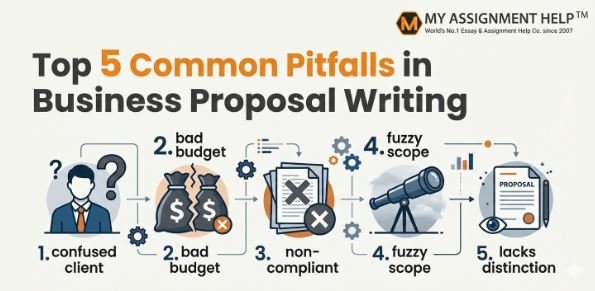
Here are the top five common pitfalls in business proposal writing that you must avoid.
Pitfall 1: Making the Proposal “The Me Show” (The Subjective Trap)
The most fatal error is a lack of client focus. Too many proposals begin with pages detailing the seller’s company history, awards, and certifications. According to a Strategic Proposal Solutions analysis, nearly 70% of proposals in the SME sector use the pronouns “we,” “us,” and “our” three times more often than the client’s name or “you.”
In the US business culture, efficiency and results are prioritized. Evaluators are scanning for solutions to their pain points. If the proposal’s introduction doesn’t address the client’s problem immediately, you lose them.
How to avoid it: Flip the script. Use a “You-We” focus. Your executive summary should lead with the client’s current challenge, the implications of not solving it, and your proposed solution’s direct outcome.
Pitfall 2: Selling “Features,” Not “Benefits” (The Value Gap)
Features tell; benefits sell. A feature is an attribute of your service. A benefit is the positive outcome that the attribute provides to the client.
For example:
- Feature: “We provide 24/7 dedicated customer service.”
- Benefit: “Our round-the-clock support ensures that any potential downtime is resolved within 15 minutes, safeguarding your daily operations from financial loss.”
Research suggests that proposals that clearly quantify benefits (e.g., ROI, cost savings, or time reduction) have a 50% higher closure rate than those with vague promises. US decision-makers are highly metric-driven. They are looking for ROI justifications to present to their own stakeholders.
Pitfall 3: Failing to Build Trust with Data and Social Proof
US corporations are risk-averse. According to Gartner, modern B2B buyers spend only 17% of their total purchase journey meeting with potential suppliers. The rest is spent on independent research and internal consensus-building.
Your proposal must do the trust-building for you. Vague statements like “industry leaders” or “cutting edge” do not work. If you make a claim, you must back it up with data.
How to avoid it: Every significant claim in your proposal should be followed by:
- A relevant statistic.
- A brief client testimonial (preferably from a similar industry).
- A case study summarizing problems solved and quantifiable results achieved.
Pitfall 4: Neglecting Clarity, Design, and Grammar
In business, clarity is power. Many technical professionals believe that a highly dense, jargon-filled document proves competence. In reality, it obstructs understanding. Evaluators are often overworked; if your proposal is hard to read, it will not be read.
Furthermore, grammatical errors or a messy, inconsistent layout communicate that you lack attention to detail. If you are sloppy on your own document, the inference is that you will be sloppy on the client’s project.
How to avoid it:
- Plain English: Write at a tenth-grade reading level, as measured by the Flesch-Kincaid scale. It ensures readability.
- White Space: Use large headings, bullet points, and charts to break up text.
- Design Standards: Adhere to modern, professional business proposal standards for the US region.
Pitfall 5: Including Vague or Convoluted Pricing
The “Investment” section is often the most scrutinized page. A fatal mistake is obscuring the costs or being unclear about what the client actually gets. Bundled pricing that doesn’t explain the components can breed suspicion of hidden costs.
In a performance-driven culture like the US, pricing must be transparent and, ideally, tied directly to the value you deliver.
How to avoid it: Use clear, itemized pricing tables. Be transparent about variables that could affect the final cost. Most importantly, frame the cost as an “investment,” always re-focusing the narrative on the ROI the client will achieve.
Key Takeaways
- Shift Perspective: Make the proposal about the client and their problems, not your history.
- Quantify Everything: Translate your features into measurable benefits (ROI, time, or cost savings).
- Validate Claims: Use case studies and statistics to build credibility (social proof).
- Prioritize Readability: Ensure the proposal is professional, error-free, and easy to scan.
- Provide Clarity: Offer clear, transparent pricing models that reflect value.
FAQ Section
Q: How long should a typical business proposal be?
A: Length depends on the complexity of the project, but for most US business scenarios, shorter is better. Aim for 5–15 pages, emphasizing clarity over volume. For RFPs, adhere to the specific page count limits provided.
Q: Is it necessary to sign the proposal before sending it?
A: Yes, in the US, an electronic signature from an executive or authorized representative is professional and adds legal weight to the document.
Q: Do I need a cover letter for my proposal?
A: absolutely. It is the first thing a recipient sees and should be personalized to establish a human connection and summarize your value proposition.
References:
- Association of Proposal Management Professionals (APMP). “2026 RFP Trends & Benchmarks Report.” (May 2026).
- Gartner. “The B2B Buying Journey: Why Buyers Prefer Digital Self-Service.” (June 2025).
- QorusDocs. “Impact of Proposal Effectiveness on Revenue Generation.” (February 2026).
- Flesch, R. & Kincaid, P. “Readability Standards in US Professional Communications.” (As cited in AI Writing Assistant, 2025).
Author Bio
Dr. Sarah Jenkins is a Senior Content Strategist and lead Academic/Professional Consultant at MyAssignmentHelp. With over 15 years of experience in technical writing, corporate communication, and educational support across the United States, she specializes in transforming complex strategies into compelling, result-oriented narratives. She holds a Ph.D. in Professional Writing from NYU and is dedicated to helping organizations achieve clarity in their high-stakes business proposals. See more